Bringing Your Whole Self to the Lab: An Interview With Max Fisher
What does true LGBTQIA+ inclusion in STEMM look like?
Pride initiatives in the pharmaceutical sector are gaining visibility, but creating truly inclusive environments goes far beyond flying the flag during designated months. Authentic inclusion means integrating support into everyday lab practices, workplace policies and professional development pathways across STEMM (science, technology, engineering, mathematics and medicine).
The International Day of LGBTQIA+ People in STEM is a vital opportunity to reflect on progress made and the work still needed to ensure that labs are inclusive spaces for all identities year-round.
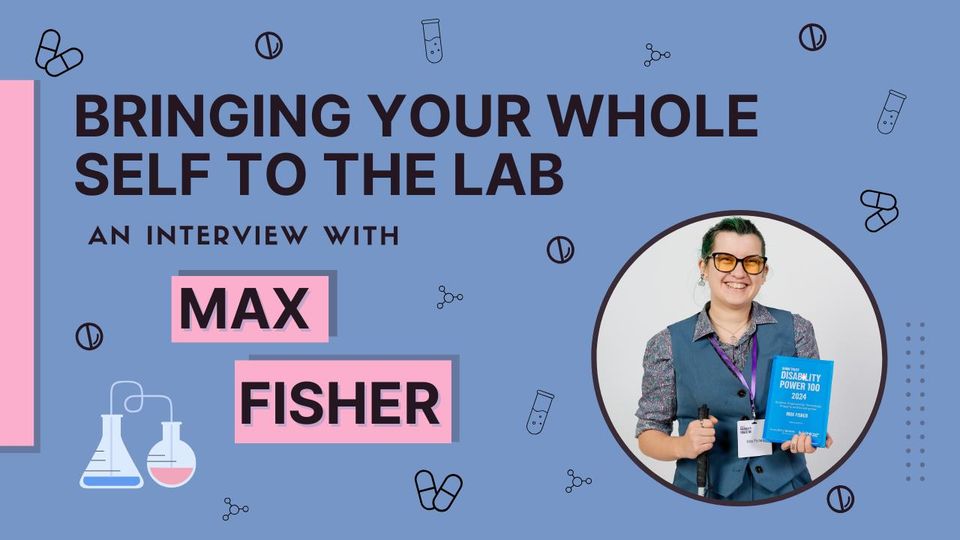
Technology Networks recently spoke with Max Fisher, a multi-award-winning disability and LGBTQIA+ activist and senior research associate, to learn more about their experiences navigating STEMM as a queer, DeafBlind and disabled scientist. Max shares how their identity has impacted their career, the progress they’ve witnessed around LGBTQIA+ inclusion in science and the changes that can make labs more supportive spaces.
What do you enjoy most about working in STEMM?
Max Fisher (MF):
There are lots of things I enjoy about working in STEMM, so it’s hard to narrow it down. I’ll start by saying I’m a cell culture nerd at heart, and I really do enjoy growing cells and keeping them happy and healthy.
I love that there is always an opportunity to learn something new, whether it’s just learning from a mistake you made or learning how to do something seriously cool. I love being able to experiment with things, and figure things out. My brain is happiest when it has something to chew on. I also love that I can still be an advocate for the things I’m passionate about and even combine that with STEMM as a Disability in STEMM activist.
I very rarely have two days that are exactly the same, which is vital! Knowing that the work I’m doing is having an impact and contributing to a better world is something very special to me.
KR:
Has your identity presented any challenges in your career? How have you overcome them?
MF:
My identity is a big part of who I am, and how I am perceived. There’s not a lot I can do about that part. There have been significant challenges along my journey. Initially, the administrative side of starting a new role was the most challenging. Many intake forms are digital and are not inclusive of nonbinary identities. I am genderqueer and I have an Mx title. I often use the word non-binary to describe myself too, depending on who I’m talking to. When these aren’t included, we have to choose something that’s inaccurate, and this doesn’t always match what other services have chosen for me. It can make it really hard to prove my identity sometimes, which is a barrier not only to work but finances, a pension and even medical care.
I also have faced people who are resistant to my pronouns. I am fortunate that my stance as an advocate has given me the confidence to have these conversations in a productive and professional manner. I’ve even hosted a lunch and learn about gender to help people learn a little bit more, not just about my experience of gender, but how gender is being studied in science.
However, my experiences in STEMM as a whole have been overwhelmingly positive. In my most recent interview, one of the interviewers used the wrong pronoun for me which happens, but then he corrected himself! That almost never happens! They had already done some of the work, which made me feel safe and comfortable joining the team, knowing I wouldn’t have to advocate for myself from the off.
I think my identity as a Disabled scientist has had more of an impact than my identity as a queer scientist, and I’ve overcome this in a similar way. Showcasing, educating and making the information accessible.
KR:
What progress have you seen in LGBTQ+ inclusion within STEMM and what areas still need improvement?
MF:
I’ve seen lots of scientists be more comfortable being out in the workplace and actively engaging with the STEMM community as queer people. I have been particularly moved by the “bring your whole self to work” ethos that has been increasingly brought into workplaces. However, their whole selves need to be not only accepted but supported too. It’s not enough just to allow people to be LGBTQIA+ openly at work; they need to be kept safe from unconscious bias, conscious bias, discrimination and ignorance.
The STEMM industry can be a little shy when it comes to hosting queer events, or queer training sessions, often being cited as unprofessional. I think focusing on community is the best way forward.
KR:
What small changes can labs make to improve inclusivity?
MF:
When I started working in STEMM, one action that made me feel supported was when someone saw my pronouns in my email signature and added hers to her email signature. Having a space for pronouns in email signature templates is a great step – they’re not mandatory by any means, but they are a little reminder, similar to optional pronouns on printed ID cards. However, when only queer folks put their pronouns in their signatures, it can inadvertently out people, so we need allies to do this too!
Things like acknowledging Pride Month or LGBTQIA+ History Month can be inclusive for everybody, especially when rainbow cupcakes are involved. This isn’t solely for LGBTQIA+ folks, either. Black History Month is essential to put on the calendar, as is Disability Pride Month, religious holidays from a wide range of faiths, and cultural holidays, too. Lean into what your team is asking for, as it’s important to them and will help them feel included.
KR:
If you could give one piece of advice to young LGBTQIA+ researchers beginning their careers, what would it be?
MF:
Keep being you! Your queerness doesn’t have to interact with your career if you don’t want it to, but it definitely can. It’s also OK to report anything that makes you feel discriminated against, no matter how small. You’re not getting anyone in trouble, you’re just highlighting a gap in training. You don’t know what you don’t know, and that applies to HR, too.
KR:
How do you balance wanting to educate others with ensuring this responsibility doesn’t just lie with you?
MF:
This is something I am particularly bad at. What’s balance? It doesn’t all have to be on me, but being an advocate is something that I enjoy, and it fills my cup. I didn’t start all at once, but that wasn’t intentional at all. Being able to set a boundary is vital. If I’m doing something complex in the lab, perhaps that’s not the best time to answer people’s questions about queer issues. I pride myself on being an open book at all times, but that’s not the only way to be an LGBTQIA+ advocate.